
Opening Lines
Behind-the-Scenes

A fellow writer asked me, “How do you open a story?”
It is a deceptively simple question and one every writer wrestles with.
I told them my first drafts are messy because they are me telling myself the story. I want to get everything down on paper before I worry about elegance. But even in that chaos, I am always listening for the line that will eventually open the piece — the line that hooks a reader hard enough that keeps them going.
“What makes a good hook?” they asked.
The honest answer is it depends. Mood, genre, timing, even what I had for breakfast can change what grabs me. But that wasn’t what they needed to hear. They wanted something they could use.
“Throw the reader into the story,” I said. “Don’t walk them in.”
“Can you give me some examples of that?”
I thought about reaching for the same two lines many reach for. Dickens: “It was the best of times; it was the worst of times.” This is a contradiction, dropped on you with no warm-up. Next Melville: “Call me Ishmael.” This is so plain it barely sounds like literature. To me, it sounds like someone leaning over a bar talking to the bartender. Both are so famous they are a little numb from being quoted.
Instead, I pulled four books off my own shelves, each one using a different strategy to shove the reader straight into the pages.
Charlene Newcomb — Battle Scars II: For King and Country
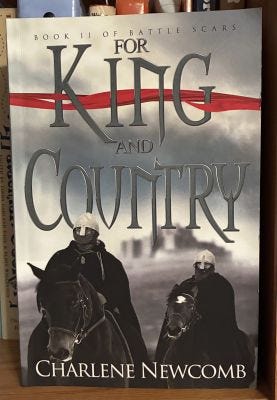
“Drums. Dear God, not the drums.”
Newcomb doesn’t open cold. She gives you an epigraph first — a knight who survived the Holy Land only to find danger waiting at home — and a dateline to anchor you in 1193. All the context is handled before the chapter even begins.
Then she drops you, with one word and a prayer, straight into fear.
Where some writers build a runway, Newcomb builds a trapdoor.
Dan Brown — Angels & Demons
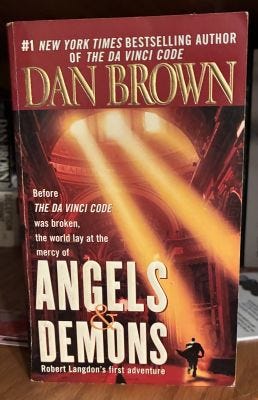
“Physicist Leonardo Vetra smelled burning flesh, and he knew it was his own.”
Newcomb splits her opening into two parts; Brown does the opposite: he loads everything into one sentence. A profession, a name, a sensory detail, then the gut-punch horror — his own.
I remember standing in a bookstore aisle, frozen.
This is an opening that doesn’t invite you in; it grabs you by the collar.
Alex Kershaw — The Liberator
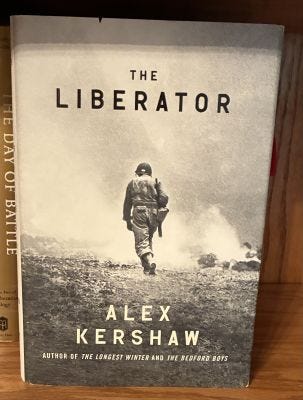
“They lay beneath perfect rows of white graves that lined lush green lawns.”
Where Brown uses shock, Kershaw uses subtlety. The word doing the real work here is perfect. Cemeteries are not supposed to be perfect. That precision is unease.
I didn’t notice it the first time I read it years ago — I only remembered the feeling. Sharing it with another writer made me see the mechanism behind the mood.
George R. R. Martin — A Clash of Kings
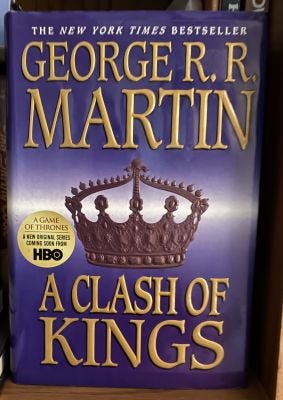
“The comet’s tail spread across the dawn, a red slash that bled above the crags of Dragonstone like a wound in the pink and purple sky.”
This one does the opposite of Newcomb. She split her opening into two pieces. Martin fuses it into a single sentence. The comet is the setting, mood, and omen all at once. The sky “bled.” It is wounded.
Four books, four completely different moves — Newcomb splitting the work in two, Brown loading one sentence like a trap, Kershaw hiding the unease in a single adjective, Martin compressing image and omen into one breath. And every one of them throws the reader in before they have agreed to go.
After that conversation, I found myself wondering whether my own published work does the same thing. I think it does in a quieter way.
The opening line of an article published last fall about Edward and Pegeen Fitzgerald begins:
“On a cold, snowy January day in 1935, the S.S. Santa Rosa glided into the Port of New York City.”
Quiet, compared to a burning physicist or a bleeding sky. Just motion. A ship arriving before you know who is aboard and why it matters.
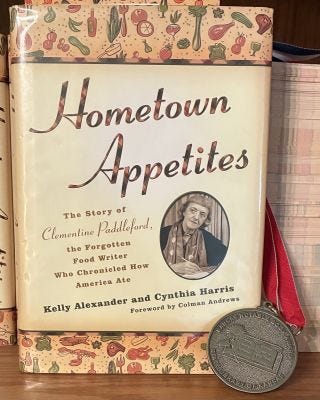
Kelly Alexander and I opened Hometown Appetites almost the same way, twenty years ago:
“As the propellers on the DC-6 slowed for a landing in Hilo, Hawaii, the passengers found the vista a curiosity.”
No name yet. No thesis. Just a plane landing somewhere nobody expected.
Closing Thought
Openings do not have to be loud to be effective. They do not need fire or blood or a sky torn open by a comet. They just need to move and make the reader move with them.
Whether it is a single shocking sentence or a quiet arrival in a harbor, the best openings do not knock politely.
They pull you across the threshold.
This would have been a fascinating post even if you hadn't included my book! Thank you, Cyn!
That was very interesting Cyn. 😁